A useful workout plan for men over 40 combines strength training, aerobic activity, and enough recovery to repeat the work consistently. The sample below uses three nonconsecutive full-body sessions. If you are new to lifting or returning after a long break, begin with two sessions and one working set per exercise, then add work only when you tolerate it well. Your training history and health matter more than the birthday on your driver's license.
This is an educational example for generally healthy adults, not a personal exercise prescription or rehabilitation program. If you have a significant medical condition, recent surgery, unexplained symptoms, or concerns about a movement, discuss suitable activity with your healthcare professional. A qualified trainer can help you learn unfamiliar exercises. There is no requirement to prove your readiness by lifting a heavy weight on day one.
What this plan is designed to do
The plan gives you a repeatable structure for practicing a squat pattern, a hip movement, an upper-body push, an upper-body pull, and simple trunk work. It is a starting point for general strength and confidence, not a bodybuilding specialization cycle. If muscle size is your main goal, the separate guide to building muscle after 40 explains how volume, food, and recovery fit together.
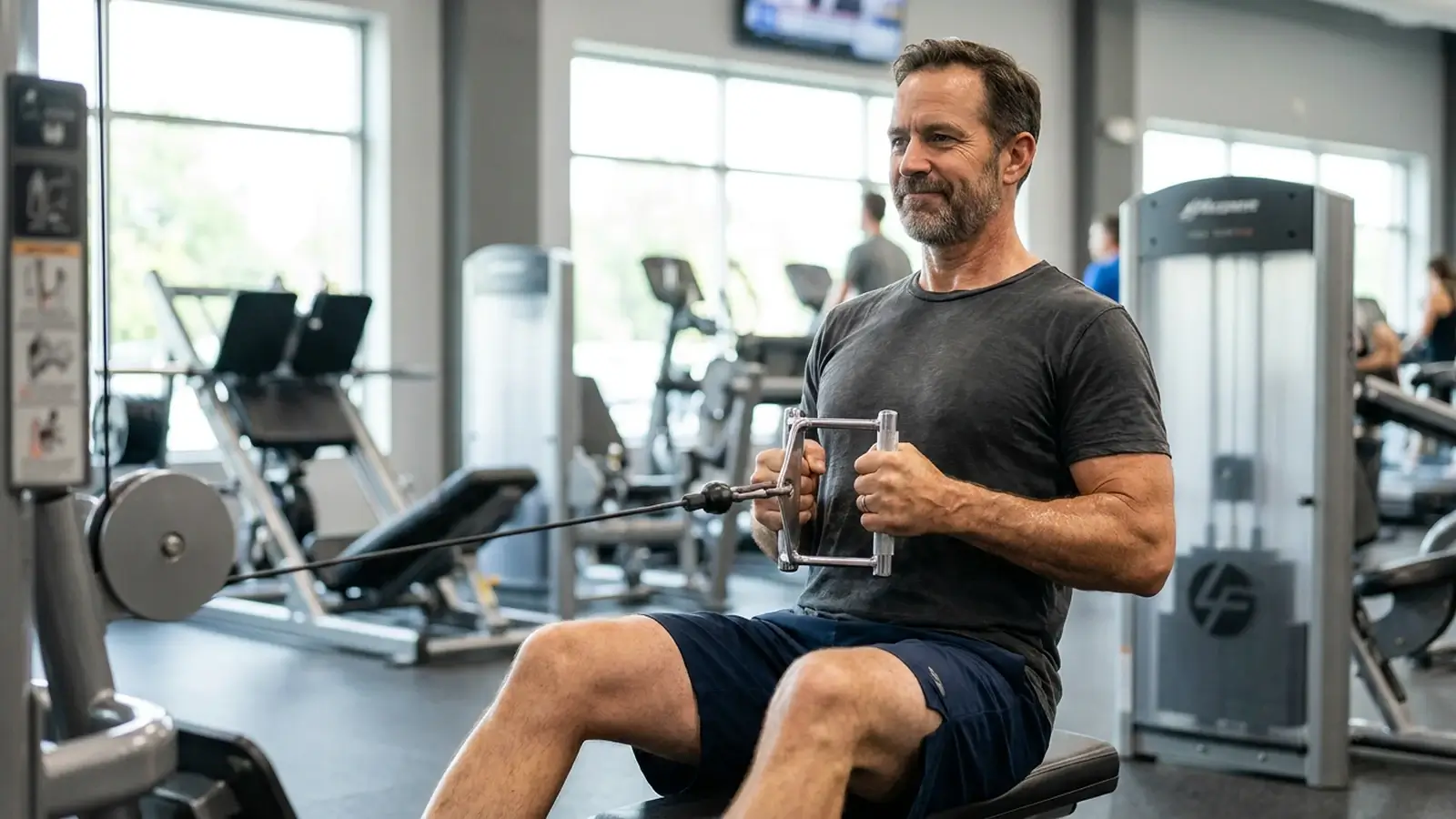
CDC guidance calls for at least two days of muscle-strengthening activity across the major muscle groups and at least 150 minutes of moderate aerobic activity weekly, or an equivalent vigorous combination. You can build toward that amount gradually and divide aerobic activity into smaller sessions. [1] The lifting plan is one part of your week; it does not replace walking, cycling, or other aerobic movement.
The American College of Sports Medicine's 2026 resistance-training update emphasizes regular participation and individualization. It also makes clear that training to muscular failure and complex programming are not necessary for the average healthy adult. [2] The modest starting dose below is an editorial application of those principles, not a claim that this exact routine was tested in a clinical trial.
Your weekly schedule
| Day | Main session | Optional additional movement |
|---|---|---|
| Monday | Strength A | A comfortable walk |
| Tuesday | No scheduled lifting | Walking, cycling, or another suitable aerobic activity |
| Wednesday | Strength B | Brief easy mobility work |
| Thursday | No scheduled lifting | Aerobic activity at a manageable effort |
| Friday | Strength C, once ready | A comfortable walk |
| Weekend | Recovery and normal life | Enjoyable activity that fits your capacity |
The weekday labels are conveniences. Tuesday, Thursday, and Saturday work too. If you are starting with two days, alternate A and B during the first week, then C and A the next week. Continue through the sequence rather than trying to cram a missed session into an already busy day. A schedule you can maintain beats one that depends on every week going perfectly.
Understand the sets, repetitions, and effort
A repetition is one controlled movement. A set is a group of repetitions performed before a rest. A working set is the portion you log as training, after any lighter practice sets. For the exercises below, begin with one working set if you are new or detrained. Move toward two sets when technique remains steady and normal daily activities are comfortable between sessions. Two is a starting target, not a mandatory minimum on a difficult day.
Use a load that leaves roughly two or three good repetitions available when you stop. That estimate will be imperfect at first. The useful question is whether you could perform another controlled repetition without straining, twisting, or changing the movement. Stop before technique deteriorates. You do not need a one-repetition maximum test to select a starting weight.
Rest about one to two minutes between modest sets, and take longer when you need it to regain comfortable breathing and attention. Avoid turning the routine into a race. Use controlled movement, a comfortable range, and steady breathing. If you are unsure how to brace or breathe for an exercise, get instruction instead of holding your breath through prolonged effort.
The three strength sessions
| Session | Exercise | Starting repetition target |
|---|---|---|
| A | Chair squat or light goblet squat | 8–12 |
| A | Incline push-up or machine chest press | 8–12 |
| A | Supported dumbbell row or seated cable row | 8–12 per side when unilateral |
| A | Glute bridge | 8–12 |
| A | Dead bug, using a manageable variation | 5–8 controlled repetitions per side |
| B | Low step-up with support available | 6–10 per side |
| B | Machine chest press or incline push-up | 8–12 |
| B | Lat pulldown or suitable resistance-band row | 8–12 |
| B | Light dumbbell hip hinge after learning the technique | 8–10 |
| B | Bird dog, using a manageable variation | 5–8 controlled repetitions per side |
| C | Chair squat, goblet squat, or leg press | 8–12 |
| C | Incline push-up or machine chest press | 8–12 |
| C | Supported row | 8–12 per side when unilateral |
| C | Glute bridge or familiar light hip hinge | 8–12 |
| C | Standing calf raise with support | 10–15 |
Repeating movements is intentional. You are learning to recognize good technique and compare sessions, not collecting as many exercises as possible. The push and pull exercises also involve the arms and shoulders. Later, an individualized program can add work for particular goals. There is no need to add several arm exercises before you know how you recover from the basic sessions.
Before the first working set
Spend a few minutes moving comfortably, then rehearse the movements with little or no load. Before a squat, practice standing from a chair. Before a press, try an easier version. Before a row, check the seat or support position. The point is to arrive at the working set prepared, not exhausted. If the movement feels unfamiliar or unstable, that day can be a learning session rather than a heavier workout.
Make substitutions without losing the purpose
If a movement is uncomfortable, do not force it because it appears in the table. A higher chair can make a squat easier to control. A higher push-up surface reduces the demand. A supported row may be easier to organize than a bent-over row. Machines can be useful when setup is clear and the movement fits you. Persistent pain deserves assessment; swapping exercises indefinitely is not a substitute for finding its cause.
For home training, use stable equipment and follow the manufacturer's instructions for band anchors and weight limits. Do not improvise a door anchor or step on unstable furniture. You can practice chair squats, incline push-ups against a secure surface, bridges, and suitable band rows without reproducing a commercial gym. Keep the surrounding area clear.
Use one simple progression rule
Record the exercise, load or variation, repetitions, and how the final set felt. If the target is eight to twelve repetitions, stay with the same load while you build comfortable repetitions within that range. When you complete all planned sets at the upper end with steady technique and repetitions still available on two sessions, consider the smallest practical load increase.
After increasing, returning to the lower end of the range is normal. If the next weight jump is too large, remain at the current weight or use a more gradual adjustment with professional guidance. Do not increase the load, sets, and number of exercises simultaneously. Changing one variable makes it easier to understand what you can tolerate.
For an illustrative example, imagine that you perform a chest press for ten and nine controlled repetitions. Next time you achieve ten and ten. Later you reach twelve and twelve without grinding. That is a reason to consider a small increase, not an instruction to double the weight. The log should make your decisions calmer, not turn each session into a test.
Know when to reduce the session
If you slept poorly, had an unusually demanding workday, or are recovering from an illness, reduce the plan or take time off as appropriate. One working set of familiar movements may fit an ordinary low-energy day. Illness or concerning symptoms may mean no workout at all. Do not use caffeine or anger to force a session your body is not tolerating.
Stop an exercise that causes sharp pain, dizziness, or unusual breathlessness. Seek urgent medical help for symptoms such as chest pressure, fainting, or severe breathing difficulty. Mild muscle soreness can occur after unfamiliar activity, but severe, persistent, or unusual symptoms should not be dismissed as proof that training worked. Ask a clinician when you are uncertain.
A missed week is not a debt. Return with a lighter, shorter session and assess how it feels. There is no benefit in punishing yourself with twice the planned work. If scheduling is the recurring problem, protect two reliable sessions before adding a third. Consistency should mean adjusting to real life, not pretending real life will stop interrupting.
Support the plan outside the gym
Eat regular meals, include a protein source, and make room for sleep. Avoid assuming that an elaborate supplement stack is required to start. If you later want to evaluate a supplement, read the evidence and limitations in our creatine guide rather than buying products to compensate for a routine you have not established.
Review the plan after several weeks. Are you attending regularly? Do the movements feel more familiar? Are your repetitions improving? Can you do the work without persistent joint pain or disruption to your everyday life? Those observations are more useful at this stage than comparing your appearance with a stranger's edited photograph.
Choose the next two training appointments now. Write down the easier variations you will use and leave room in the log for what actually happens. The first goal is a repeatable session you can recover from. More advanced training can come after you have built that foundation.